
Why the strongest quality systems begin with the people behind them
“Quality is never an accident. It is always the result of committed people making the right decisions, even when no one is watching.”
When we talk about quality in healthcare, our minds often go straight to accreditation standards, quality indicators, audits, procedures, and technology. These are essential components of every high-performing healthcare organisation. Yet, one critical question is often overlooked:
Who brings these standards to life?
The answer is simple: people.
Every laboratory result, every patient interaction, every correctly identified sample, and every timely diagnosis is ultimately influenced by the people working within the system. Technology supports quality, but people create it.
The Hidden Side of Quality
Many healthcare organisations facing high staff turnover, burnout, or declining engagement respond by revising procedures or investing in new equipment. While these actions are important, they rarely address the root cause.
Quality does not begin with processes. It begins with culture. And culture begins with people.
A culture of quality exists when healthcare professionals choose to act with responsibility, integrity, collaboration, and continuous improvement—not because policies require it, but because these values have become part of their professional identity.
Looking Beyond Behaviour
One of the most powerful ways to understand organisational culture is through Neurological Levels developed by Robert Dilts, a framework widely used in leadership and organisational development.
The model reminds us that visible behaviours are only the surface of a much deeper system.
Environment “What conditions do people work in?”
Staffing levels, workload, equipment, leadership support, communication, and psychological safety all influence performance. If the environment constantly creates pressure, quality becomes difficult to sustain.
Behaviour “What do people actually do?”
- Following procedures.
- Double-checking results.
- Reporting incidents.
- Helping colleagues.
- Communicating effectively.
These are the visible expressions of quality—but they are driven by deeper factors.
Capabilities “What are people capable of?”
Clinical competence alone is no longer enough. Healthcare professionals also need:
- communication skills
- teamwork
- emotional intelligence
- problem-solving
- resilience
- leadership
A culture of quality is therefore not only a management responsibility. It is also a personal commitment to continuous development.
Beliefs and Values “What do people believe?”
Every organisation develops its own internal narrative. Some teams believe: “Every patient deserves our very best.” Others quietly begin believing: “No one notices our efforts.”
The difference between these two beliefs shapes motivation, engagement, and ultimately performance.
Identity “Who am I within this organisation?”
Do laboratory professionals see themselves as:
- operators? or
- guardians of patient safety?
Identity influences every decision people make. When professionals feel respected, trusted, and valued, they naturally contribute more to organisational excellence.
Purpose “Why does our work matter?”
Every laboratory sample represents a person waiting for answers. Every accurate result may change—or even save—a life.
Purpose reconnects healthcare professionals with the reason they entered the profession in the first place. Without purpose, engagement fades. Without engagement, quality eventually follows.
Quality Is a Personal Journey
Accreditation can define standards. Technology can improve precision. Policies can establish expectations. But none of these create excellence on their own.
Excellence begins when healthcare professionals choose to grow beyond technical competence. It begins with developing the mindset, values, leadership, communication and responsibility that define truly outstanding professionals.
A New Perspective on Excellence
Healthcare excellence should not be measured only by compliance with standards. It should also be measured by the strength of the culture that supports those standards.
Because procedures may define quality, technology may enable quality…But people sustain quality.
Building a culture of quality is a shared responsibility. Organisations must cultivate an environment that enables learning, trust and development, while healthcare professionals must take ownership of their own growth, competence and contribution to patient care.
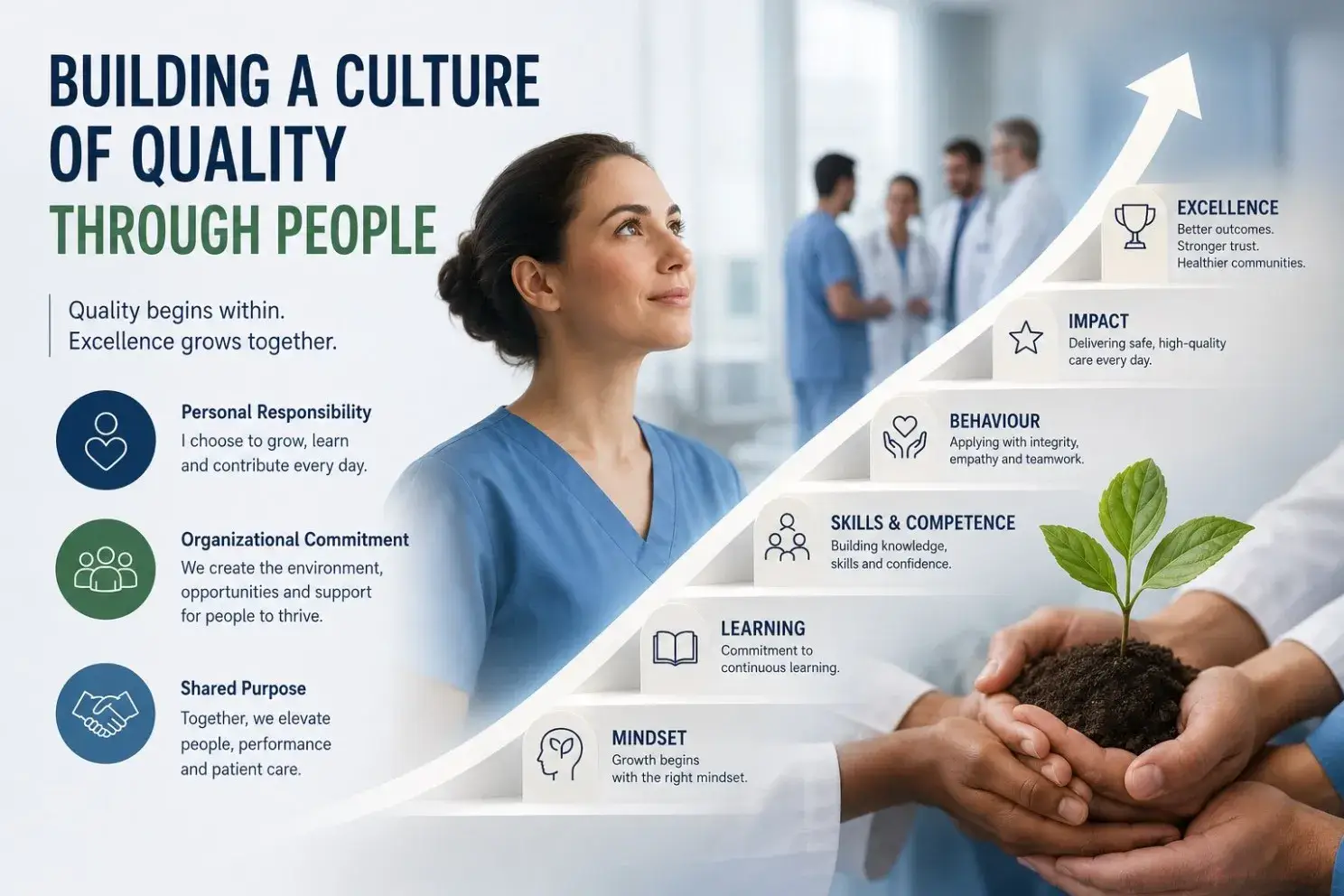
At HR Healthcare Hub, we believe that healthcare transformation starts with people. Developing excellent healthcare professionals means developing individuals who combine clinical competence with leadership, emotional intelligence, collaboration, ethical responsibility and a lifelong commitment to learning.
Within the Healthcare HR Excellence Framework, mindset coaching serves as starting point for developing healthcare professionals who lead with purpose, grow with intention and contribute to a lasting culture of quality.
This article is part of the Healthcare HR Excellence Framework initiative developed by HR Healthcare Hub, starting point exploring how leadership, culture, and human capital shape safer, more resilient, and higher-performing healthcare organisations.
HR Healthcare Hub,
Your HR Solution Partner – HR medics
Chapter 2 Building a Culture of Quality Through People
